















Resource ● Last updated 31 October 2023 ● 8 min read
Private road disputes (NSW) – Making a claim in court

In this article
Print & save
Share
What is this resource?
This resource provides a general overview of the relevant jurisdictions and types of claims to a private roads dispute.
If the road user or the owner of the road does not wish to participate in Alternative Dispute Resolution, or they have been unable to reach an agreement via Alternative Dispute Resolution, they can initiate legal action.
This resource does not contain extensive information on how to prepare the claims.
This resource includes:
- Commencing a claim as a landowner
- Commencing a claim as a neighbour or other party using the private road, where:
- they have suffered harm
- they have not suffered harm but have an easement and require the road to be repaired
- they have not suffered harm and do not have an easement, or the right to one.
- Drafting statements of claim
Commencing a claim as a landowner
A landowner may bring various claims against a road user to recover the costs payable in proportion to the terms of the relevant easement for access.
If a road user does not hold a registered easement over the road then they are not required to contribute to the costs of repair. If this is the case, the landowner may prohibit their use of the road by erecting gates or otherwise prohibiting entry.
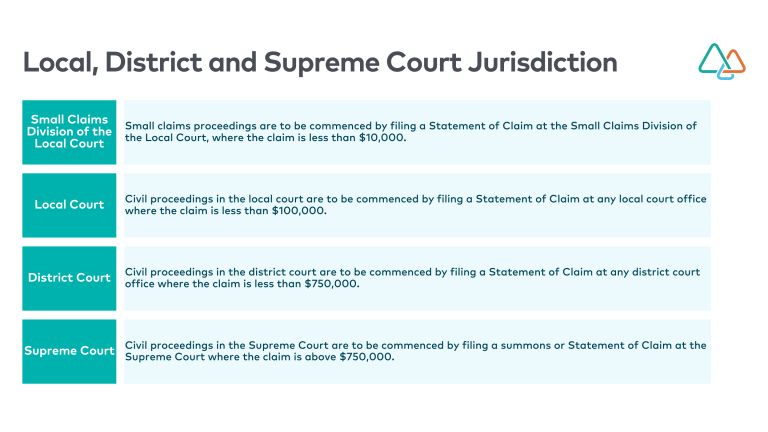
Claims of less than $10,000 are brought and heard in the Small Claims Division of the Local Court. Small claims proceedings are conducted with far less formality than most other civil proceedings and the costs involved in commencing proceedings and litigating a dispute are much smaller.
Claims greater than $10,000 may be brought in the Local, District or Supreme Courts, depending on the monetary value of the claim.
Commencing a claim as a road user
If you are acting for the private road user:
How you take action will depend on whether your client has suffered any harm.
A neighbour or third party using a private road can make a claim for monetary compensation if they have already suffered harm. A claim is to be commenced in the court in which it will be heard and the relevant court will depend on the amount of money being claimed from the owner of the private road.
The claim must be brought within 3 years from the incident the claim is based upon.
The following thresholds will determine the court in which the claim will be brought and the required documents.
A third party is only entitled to request the road to be repaired where they are an interested party under an easement.
If your client qualifies for an easement of necessity but does not yet hold one, see further information on making an application here: Private road disputes – Acting for a road user – Justice Connect
If a dispute arises between the owners of the dominant and servient lots about who has responsibility to repair the road which cannot be resolved directly or through alternative dispute resolution, the claim would be initiated in the Supreme Court of NSW.
The general public is not entitled to request a private road to be repaired and the private road owner may prohibit access to the private road by a gate and lock or by other means.
If your client has no right to access the land (i.e. a right of carriage way or easement of necessity) they have no standing to commence a claim.
You should advise a client early in the process that they do not have the ability to commence a claim in situations where they have no legal right to access the road and do not qualify for an easement of necessity.
Statements of claim
A statement of claim is a written statement that sets out the facts of the case and what it is your client is seeking.
You can use this statement of claim form where the filing party is legally represented:
The best way to draft a statement of claim is to write a series of numbered short paragraphs, each containing a separate fact that is central to the claim. If the statement of claim does not accurately outline the claim, or if parts of the claim are inadequate or do not comply with the rules, the court may decide to throw out part of the claim or the whole claim in its entirely.
How to make a referral for pro bono legal assistance
Justice Connect connects eligible individuals, small business owners and primary producers and community organisations affected by disasters like floods, bushfires, cyclones, and other extreme weather events, with free legal help.
Refer someone to Justice Connect
I need to refer someone – Refer to Justice Connect
LawAccess NSW
LawAccess is a free government service that provides legal information and referrals, including to Legal Aid NSW, for people with a legal problem in NSW. See their website for more information on how they can help.
This resource was last updated on 31 October 2025. This is legal information only and does not constitute legal advice. You should always contact a lawyer for advice specific to your situation. Please view our disclaimer for more information.
More disaster resources for community lawyers
Disaster Legal Support Resource Hub
Our resources are designed to help community legal workers find high-quality legal information quickly, and take steps to resolve their clients’ legal problems and refer their clients for pro bono legal support before their problems escalate.